We Analyzed 100,000 Job Postings to Find Out Which Jobs AI Will Replace First
Spoiler: IT professionals are at risk, plumbers aren't. An analysis of 121,157 job postings from hh.ru, ranked by AI displacement risk.
Coworker
March 27, 2026 · 5 min read
Contents
Spoiler: IT professionals are at risk, plumbers aren't
Whenever people talk about robots replacing humans, they usually picture delivery drivers and cashiers. The logic is simple: if a robot can deliver a pizza or ring up a receipt, you don't need a person.
But we decided to put that to the test. We pulled 121,157 job postings from hh.ru, narrowed them down to 173 unique roles, and asked three different language models to score each profession on a scale of AI displacement risk.
The scale is straightforward: 0 means AI doesn't even understand what you do, 10 means your boss is already googling "how to plug ChatGPT in instead of a whole department."
What we did
We exported job postings from hh.ru. We kept only the ones where:
- The description was longer than 300 characters (to filter out the noise)
- A salary was listed (a marker that the position is serious)
- There was a list of required skills
- The role wasn't tagged "Other" (otherwise the analysis is meaningless)
Out of 121,000 postings, 173 roles remained. For each one we wrote a detailed prompt grounded in the realities of the Russian market: the 1C ecosystem, regulatory requirements, and the maturity of Russian LLMs (YandexGPT, GigaChat). We asked three independent models to assign a score from 0 to 10.
The average across the three models became the final score. The models, by the way, were surprisingly unanimous. Apparently even AI agrees on who should be replaced first.
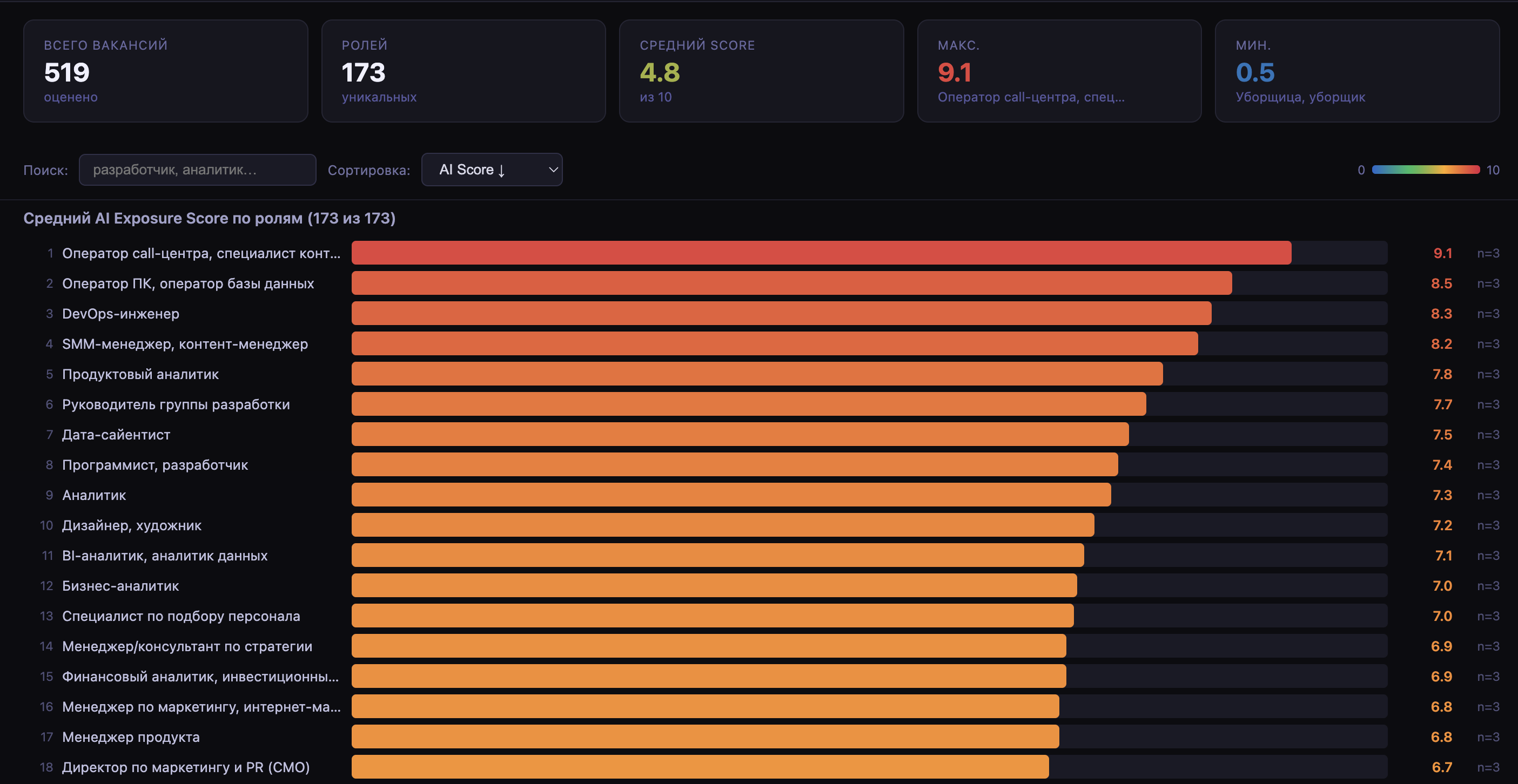
The top 10 jobs in the firing line
| # | Profession | Risk |
|---|---|---|
| 1 | Call center operator | 9.3 |
| 2 | Data entry / database operator | 8.7 |
| 3 | DevOps engineer | 8.4 |
| 4 | SMM manager, content manager | 8.3 |
| 5 | Product analyst | 8.0 |
| 6 | Engineering team lead | 7.8 |
| 7 | Data scientist | 7.6 |
| 8 | Programmer, developer | 7.5 |
| 9 | Analyst | 7.4 |
| 10 | Designer, artist | 7.3 |
Quite the plot twist, isn't it?
Programmers scored 7.5. Data science came in at 7.6. DevOps is actually in the top three for risk. This doesn't mean every developer will be out on the street tomorrow. But the models see it clearly: the output of the work is code, code is what LLMs write, so a chunk of those tasks gets automated. The irony: the people who built AI are first in line to feel its impact.
SMM manager at 8.3 makes perfect sense. Cookie-cutter posts, hashtag selection, generating visuals. If you spend 70% of your time on routine work, AI is already here. And it isn't asking for a raise.
What about the "safe" jobs?
| # | Profession | Risk |
|---|---|---|
| 173 | Cleaner | 0.3 |
| 172 | Welder | 0.5 |
| 171 | General laborer | 0.7 |
| 170 | Painter, plasterer | 0.9 |
| 169 | Street sweeper | 0.9 |
| 168 | Mechanic, plumber | 1.1 |
| 167 | Massage therapist | 1.1 |
| 166 | Mover / loader | 1.2 |
Also about what you'd expect. Physical labor is staying put. A robot plumber is, for now, expensive, complicated, and unnecessary. Try explaining to a neural network how to replace the washer in a faucet inside a 1962 walk-up apartment building - it'll give up by the third iteration.
But here's an interesting detail: a hairdresser (1.5) is safer than a programmer (7.5). Five years ago nobody would have believed it. Today the programmer is eyeing their barber nervously, thinking, "Maybe it's time to learn how to cut a fade."
What surprised us
Product analyst (8.0) is at greater risk than a programmer (7.5). The explanation: code is a complex task with countless dependencies, context, and architectural decisions. Analytics is template-driven data processing, visualization, and report preparation. LLMs already do this today - and without smoke breaks.
QA tester (7.1) is also in the danger zone, and that makes sense. Automated tests, regression, API checks - AI can already generate and run all of it. Manual testing of complex scenarios is holding on for now, but the line moves with every model update. If your job is clicking through forms against a checklist, it's worth thinking ahead.
Lawyer (5.8) and doctor (5.5) sit in the middle of the table. Even though many consider their work irreplaceable, the models factor in the specifics of the Russian market: certification, government regulation, personal liability. Replacing a judge with AI is impossible even technically - the law won't allow it. Although, hand on heart, some court rulings already look AI-generated.
How the risk is distributed across the scale
Our entire dataset paints an interesting picture:
- High-risk zone (7-10): operators, digital analysts, developers, designers, SMM. This is roughly 15% of roles.
- Medium-risk zone (4-6): managers, accountants, doctors, lawyers, logistics specialists. 38% of roles.
- Low-risk zone (0-3): physical labor, services, repairs. 47% of roles.
The main takeaway
AI isn't a threat to movers. AI is a threat to office workers who do routine digital processing.
If your job is writing copy from a template, pulling together reports in Excel, shuffling data from one system to another, or answering standard questions - you're in the risk zone. And no, "I've been doing this for 15 years" is not an argument. AI does it in 15 seconds.
If your job is fixing a boiler, cutting clients' hair, negotiating unique terms, or designing a building with unconventional constraints - you're safe for now. The key phrase being "for now."
Methodology
- Exported job postings from hh.ru (121,157 of them)
- Filtering: description > 300 characters, salary listed, skills present, role defined
- Clustering down to 173 unique roles (one posting = one score)
- A prompt with a detailed scale and adjustments for the Russian market
- Three independent models - the average as the final result
- JSON responses, validation, aggregation
The data is available on request. If you want your own role category included, ask in the comments.
Put it into practice
Connect your services and hand this task to an AI agent — no manual routine, no spreadsheets.